Thursday, May 3, 2012

The Vietnam Memorial


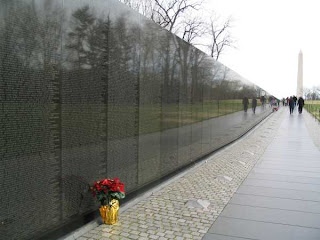
     Families around the world are struck with pain and sorrow due to the loved ones that did not return in the Vietnam War. Americans wanted a way to remember these warriors that put their lives down to help our country. So for this case, the Vietnam Veterans Memorial was built.
     The United States have been involved in Vietnam   interactions for more than 20 years, starting on May 7, 1954 and ending on April 30, 1975. The United States troops were involved in Vietnam in 1954 but the full fledged war did not officially start until 1964. The Vietnam Memorial was then dedicated in 1982 and was built in Washington D.C. Lost family members and close friends are still honored to this day with flowers, notes, and many other close items that may have been used in the family. There are 58,256 names of the memorial, one of them being my great uncle, Charles Sargent Moore.
     The reason I chose this topic was because I have relatives that fought in the Vietnam War, such as, my grandfather, Major Raymond Tomlinson, and my great uncle, Captain Charles Sargent Moore. Charles Moore died in Vietnam, from a plane crash, and is one of the many thousand honored on the wall for veterans. I wanted to search further into Charles Moore's time in Vietnam and I found a very useful website that had letters written to him from close friends that knew him. A man by the name of Frederick S. Nicoll posted this letter to Charles Moore saying that he was a "humble" gentleman with a lovely wife and two beautiful children. Frederick was Charlies nest door neighbor and he goes on to say that even though Charles was a Captain, he wanted to be called "Charlie". There was another letter that I found that was written by a fellow pilot of Charlies, a man by the name of Jim Haslitt. Jim describes Charlie as a man who led by example and always wanting to get in on the action. He also talks about the loss of Charlie when his plane went don and he says that "we lost a fine gentleman and an outstanding officer". Every summer when I was little, my grandparents took me and my two younger brother to Washington D.C. to honor the Vietnam Memorial. As you can see in the picture below, I am pointing to my Charlies name. I know it is hard to read but if you look closely it reads, Charles S Moore. If you want to know more about Charlie, click here.
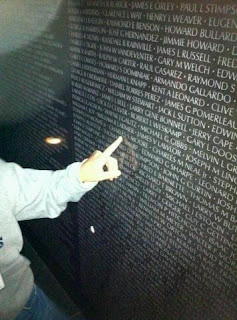
Me pointing to my great uncles name
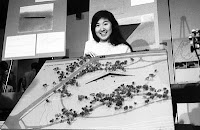
Maya Lin and her design
     "The National Vietnam Veterans Memorial may well have generated more controversy than any work of architecture in recent history." -- Nicholas Copasso. I think this quote represents the whole controversy about the Vietnam Memorial very well. The whole controversy started from a Vietnam veteran named Jan Scruggs. Jan initiated a hard fought battle to build the memorial for the veterans in the middle to late 1970s. President Carter finally approved of this plan in July of 1980. From there, Carter announced a design competition that started on November 11, 1980 and would end on March 31, 1981. Maya Lin was then selected as the winner on May 1st of that same year.
The Vietnam statue 
     The controversy of this began almost immediately after she was elected the winner. Powerful critics, led by Tom Carhart, were enraged by this design. Tom called the design a "black gash of shame" which was an insult to the Vietnam Veterans. Senator Warner conducted a meeting to add an additional flag and statue to Lin's design but that was not placed into it until later. Lin was not too happy about the changes in her design though because she thought it would violate the honor of her work. So another meeting was conducted by the Commission of Fine Arts to discuss the location of the statue and the flag. After the dedication of the flag and the statue in 1984, the move for a women's memorial was initiated. But when the Commision of Fine Arts rejected the plan to place changes in the design, congressional actions authorized a bill for the memorial and its location that was passed in November 1989.
     It is amazing to me that so much controversy and disagreement can take place to honor the loved ones that did not return from the travesties of the Vietnam War. Although I may not understand the hardships from the construction of this memorial, I do understand the hardships of the family members that lost loved ones. As I said earlier in the paper, my great uncle was one of the many thousand that did not return. I still remember the times I spent with my grandparents when I was younger when they took me to see the memorial. My grandfather loved seeing these kinds of things because he is a Vietnam veteran also. Still today, thousands of people visit the memorial to remember the loved ones lost and place close memoirs such as flowers, notes, and many others.

Thursday, April 26, 2012

Tuesday, April 3, 2012

Photographs from the Great Depression

Dorothea Lange, The Water Supply, August 1935
This picture represents the lack of water supply that people during the Great Depression suffered from. People during this time were driven to the Midwest because of the unemployment rates, drought, and loss of farm tenancy. The depression was a difficult time for most Americans and caused most of them to go unemployed or left without a food source and sometimes even lived on streets. Many people went to the Imperial Valley which guaranteed the people a supply of water for irrigation. I chose this picture because I thought it would represent how difficult Americans had to work just for a simple water source.

Sunday, February 12, 2012

Chicago Race Riots


     When i was assigned the Chicago Race Riots i was excited because i already had an idea of what it was about because earlier in the year we discussed race problems in Alabama. I am also interested in exploring how the riots were spread in Chicago during the WWI era. Also in the process of researching i expect to find who started the riots and why they were started. So for now, ill just talk about the riots in Chicago, so enjoy!!!!!!!!
   
     The first thing i wanted to look up was who started the riots in Chicago. I discovered that the African-Americans were heavily segregated in the South part of Chicago and residential areas engaged in sort of a civil war between them and the whites. The interesting thing about this was that there were more than just one massive riot, there were 25. What i also wanted to know was how people looked at Chicago after these riots. Chicago earned a reputation of large violence during this time. This website was very useful to my research and served to answer a a few of my questions going into this topic.
     
      I also wanted to learn why the riots started and i found a lot of sources with information that answers this question. Many of the whites were determined to keep blacks away from being equal to them in almost every way such as employment, housing, etc. There was also a lot of tension after the war due to political changes in the government. President Wilson said that the white-race was the reason for riots and efforts were made to promote peace between the the races. 


     What actually triggered the riots to break out? Earlier I mentioned that African-Americans sought out equal rights, but is that the whole reason for the riots? No. Many of these riots were caused by a disturbance in politics and the economy but the most famous of the riots took place on a July afternoon. This riot was caused from a drowning of Eugene Williams. Eugene was an African-American that was hit by a stone thrown by a white man. This angered many African-Americans and once the riots started armed gangs piled up and opened fire with the whites. 
     Gangs played a big role in these racist riots during this time. For over a month immense and brutal fighting was going on between African-Americans and whites. The whites took a lot of the African-Americans out of work and many out of a place to live. When the riot was over, many causalities occurred for the African-Americans. Over thirty-eight people were dead, 537 were injured and about 1,000 ended up homeless. As you can see, the African-Americans were greatly effected by these riots and racial incidents.


     After reading and discussing the topic of the Chicago race riots, it really opened my eyes and changed my viewpoint on the issue. This shows that African-Americans literally had to fight for their rights and their freedom. The amazing part about this whole issue is that the African-Americans would not settle for anything less than they already had, they wanted to be treated equally as a white citizen was treated. 
   

Monday, January 30, 2012

WWI Archive: Application for the Army

I chose an official document from the archive that explains how a young man applied for war. The set date was in November of 1914 in Cowdenbeath, Scotland. The author who made this application was and eighteen year old boy named William Binning, He declared himself "fit" to serve his country in war. When he was appointed, he started at Second Lieutenant for the 11th Battalion The Cameronians or the Scottish Rifle group. I thought this was interesting because it showed that many young men, like William, wanted to help serve their country and fight in war. It took a lot of brave men to do this.

Tuesday, January 24, 2012

Great White Fleet post #2

I learned many new facts that i used to send to my family back home and some cool pictures that were used when the fleet was actually at the places!
          http://www.loc.gov/rr/news/topics/greatfleet.html
          http://www.greatwhitefleet.info/
          http://www.history.navy.mil/faqs/faq42-1.htm
          http://www.history.navy.mil/library/online/gwf_cruise.htm

Thursday, January 12, 2012

Great White Fleet Info

I have learned so far that the Great White Fleet got their name because there was a fleet of battleships sent around  the world by President Roosevelt and they were painted white. They manned about 14,000 sailors and covered more than 43,000 miles which shows they were pretty dominant

Monday, November 7, 2011

Architecture in the hands of Frank Lloyd Wright

Architecture has always played a huge role in our society, especially in the 19th and 20th century. Without our architectural advances in the modern world, where would we be? Our whole society revolves around architecture and without it we wouldn't have any work or structures such as cars, houses, stores, museums, bridges, and many more structures that play a big role in our lives. Frank Lloyd Wright set the tone for modern architecture by creating his own style of building materials. He has inspired many young architects to push themselves to benefit the community.

Frank Lloyd Wright was born in Richland Center, Wisconsin on June 8, 1867. His parents were William Cary Wright and Anna Lloyd-Jones. Since the day of his birth, his mother wanted him to be an architect. She helped and encouraged him all his life and when he was nine he made the announcement that he would be the greatest architect in the world. He attended Madison High School but later dropped out to begin his architectural career for the Dean of the University of Engineering Department, Allan Conover. Since that day he had created over 700 churches, houses, schools, theaters, museums, stores, and office buildings.

Frank Lloyd Wright exerted the greatest influence on the 20th century design by creating his own style, called organic architecture. He also created a style of homes used frequently in America called Usonian. Creating some of the most famous structures and buildings in America, Wright has made his mark in history. His first project ever designed was the Unity Chapel, also known as the Lloyd-Jones family chapel. He designed the chapel in Chicago under the work of Lyman Silsbee. Another one of his famous buildings was the Taliesin West which is a 600 acre complex near Scottsdale, Arizona. Interestingly enough, Wright has also created a house in the state of Alabama. This house is known as the Rosenbaum House, which is located in Florence, Alabama and is the only house open to the public in the southeast of his work.

As Wright grew up, he wanted to express himself in more of an architectural way. By doing this, he has created his own philosophies of architecture. One of his final structures to design was the Guggenheim Museum which relates back to his younger years of architecture. When Wright first started his architectural career, he worked for Louis Sullivan, he introduced an abstract way to design buildings and based many of his works on nature. He based the Guggenheim on a spiral which he made in New York and is viewed as a masterpiece to many people. 


Frank Lloyd Wright was viewed as a radical to many because of his different view points and styles of architecture. But Wright thought of this as a way to express himself in many ways. Publishers said that he could have made a lot of money by following societies way of thing but Wright decided to stick to his own methods and styles. Wright has drastically changed the way people think and view architecture. He sure got me up on my toes, and every time i see a unique structure or building, I think of how tough it could have been for Wright to push his ideas throughout the nation. 

Tuesday, October 25, 2011

Halloween

Once a year, Americans gather around to celebrate a special day to us on October 31, also known as Halloween. People dress up in all sorts of costumes and go from house to house in search of delicious candy. Halloween is not only known for a celebration but it is also known for its scary side. A day for myths, ghosts, story telling and many more fun activities. People get so distracted with the fun and all the activities that come along with Halloween, such as decorations and candy, no one takes the time to realize what they are spending on the stuff. With all the different types of stuff to buy, from skittles to popcorn or from blowup materials to lights, the National Retail Federation is predicting that Halloween spending will hit $6.9 billion this year! Although the spending may not compare to Christmas, it is still a drastic amount when spending that much on just candy and decorations. People may soon start to consider the time, effort, and cost, that Halloween can be.

Thursday, October 13, 2011

Nation of Immigrants

There are many perspectives that can be looked at when the United States is known as the "nation of immigrants". One perspective is optimistically. Some people take advantage and interact with the many cultures that come into the United States. For example, most schools are teaching some sort of foreign language to the students so that they will have some sort of knowledge of the future immigrants into the United States, such as, Spanish, French, Latin, and many more. The other perspective is pessimistically. Some people could be furious and on the verge of outbreak with the immigration that is going on. People can be so prejudice with peoples race that leads to many problems. I do think that this has changed life in America dramatically because no too long ago blacks were not even allowed to interact with whites and now immigrants from all over are entering the United States.
I am not very aware of my ancestors like the people were in the video we watched in class: "Faces of America".  I have never had the opportunity to go back and look back of my family lineage. That is something that i would like to have more intrest in and maybe invest in something like it one day. 

Wednesday, October 12, 2011

Faces of America

Many people question the family heritage and wonder where they were originated from, but very little actually get the opportunity to explore it. In the video "Faces of America" many people such as Yo-Yo Ma, Kristi Yamaguchi, Eva Longoria, Mario Batali, and many others get this wonderful opportunity. The excitement of this video is the curiosity and surprises that fill the mind with such information about their families past. As Yo-Yo Ma said in his interview; he has no idea what to expect but is full of curiosity but has always wondered where the "Ma" came from. Also Mario Batali is a great example for a person that has royalty in his blood lines and not even knowing it.
From watching this, one might be so inspired to go out and search their own family heritage.  People can learn so much about their families past and where they came from; whether it is from poor or rich. It is great to see how the people react to something as small but so big in their life as a family tree. People will start to appreciate the small things in life after seeing this video or learning about heir heritage.

Monday, September 26, 2011

Carnegie and his success

Andrew Carnegie began his career as an industrialist businessman who later expanded his career in the steel industry in the late 19th century. Not only was he an important businessman of his time but also an important philanthropist. Many people accused him of being a socialist for the gifts of mankind. Not only were they pleased to have them but some accused him of giving millions to prostitute universities. Many years later, the public looked back upon his gifts as a charity fund for over 2 billion dollars. He invested much of his money into libraries, communities, universities, and international peace. Most of his so-called "funding" for the public began in the late 19th century; in 1901, 1910, and 1911.